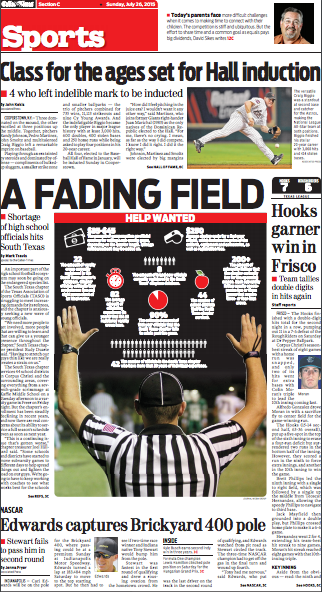
 PDF : A Fading Field as it ran
First ran in Corpus Christi Caller-Times · July 26, 2015
A Fading Field
With veteran refs stretched thin and few newcomers sticking around, South Texas’ officiating shortage is starting to reshape the football schedule.
By Mark Travis
An important part of the high school football ecosystem may soon be going on the endangered species list.
The South Texas chapter of the Texas Association of Sports Officials (TASO) is struggling to meet increasing demands for its referees, and the chapter is anxiously seeking a new wave of young officials.
“We need more people to get involved, more people that are willing to learn and that can give us a younger presence throughout the chapter,” South Texas chapter president Rudy Duarte said. “Having to stretch our guys thin like we are really creates a strain on us.”
The South Texas chapter services 44 school districts in Corpus Christi and the surrounding areas, covering everything from a seventh-grade scrimmage at Kaffie Middle School on a Tuesday afternoon to a varsity game in Freer on Friday night.
But the chapter’s enrollment has been steadily declining in recent years, and now there are real concerns about its ability to service a full season’s schedule even as soon as next year.
“This is a continuing issue that’s gotten worse,” chapter treasurer Joel Hilliard said. “Some schools and districts have started to move subvarsity games to different days to help spread things out and lighten the load on our guys. We’re going to have to keep working with coaches to see what works best for the schools and for us.”
Subvarsity games have become the most difficult matchups for the local chapter to service because those are the games typically called by new officials, which the chapter is severely lacking.
Without any new referees to take on the responsibility, some of those assignments are now going to veteran officials who already have an important place on a varsity crew, which only compounds the problem.
“It adds wear on the body for officials that are already on varsity crews,” said Billy Gaines Jr., who has more than 25 years of officiating experience in the South Texas chapter. “And as we get older, our bodies don’t recover, so it’s a lot tougher to go out and call games two or three times during the week and then be fresh for Friday night.”
Some school districts have taken it upon themselves to alter their subvarsity schedules to better accommodate the officials.
“One thing we do is we combine all of our subvarsity games at one location,” said Andres Martinez, Odem’s head football coach and athletic director. “We do that to help the officials and their crews. But we could use a lot more officials. It would make everyone’s job a lot easier.”
The chapter’s dwindling enlistment doesn’t just affect subvarsity games; currently there are 22 active varsity crews, which chapter officers believe is more than five crews short of an ideal roster.
“There were two Fridays on the schedule for this upcoming season that had more games than we had crews available,” Hilliard said. “We worked with the schools to move the games to Thursday or Saturday, but that makes it harder on the schools. Thursday games disrupt school for the following day, and Saturday games give the kids less recovery time for the next week. It really puts all of us in a bind.”
Rescheduling varsity games, having skeleton crews called into action on short notice and the expedited promotion of junior officials who wouldn’t normally be ready for a spot on a varsity crew all are examples of how close the shortage is to ballooning into a real problem not only for TASO, but for various school districts across South Texas.
“The UIL spoke about the shortage of officials at a recent coaching clinic,” said Brenda Marshall, CCISD’s athletic director. “They mentioned that they are looking at increasing their pay scale as a way to entice newer officials. In the future, we may have to start playing fewer (varsity) games on Friday nights to get on the same page with the officials.”
“We’re overloaded with games,” said Dotson Lewis, a varsity crew chief who is entering his 70th year as an official this season. “I expect that soon it will reach the point where the coaches have to start officiating seventh and eighth grade games because we won’t have enough officials to service a full schedule. It’s starting to reach that point.”
The chapter is doing everything it can to attract a younger crowd, but it also recognizes the roadblocks that are preventing it from expanding its roster with fresh faces. Whether it’s the wear of the job versus the relatively minor compensation or the fact that people in their 20s and 30s are often trying to begin a family or get started on their professional career, it’s tough for TASO to get a grip on the younger generation.
“Over the years, you could see this coming,” said Tom Allen, Sinton ISD’s athletic director and head football coach. “Back when I was in school, it was hard to earn a spot on the field as an official. Now less young people are getting involved, and the pool is shrinking. It really affects (coaches) a lot.”
That said, there is one particular demographic the chapter is trying to tap into that may prove to be fertile: College students.
The chapter has been in touch with the kinesiology departments at Texas A&M-Corpus Christi, Texas A&M-Kingsville and Del Mar College, and it hopes to have booths set up during registration at those schools to help spread awareness about the open positions within the chapter.
Additionally, the University Interscholastic League (UIL), which governs all athletic competitions for public schools in the state, has set up a statewide program that encourages high school coaches to find one graduating senior from their football team interested in officiating and to steer them toward their local chapter.
“Officiating is an ideal job for a college student,” said John Patino, the South Texas chapter’s secretary. “It fits their schedule since most of our games are in the evening, it puts some money in their pockets, it familiarizes them with the community. And when they graduate, they have a skill that they can put on their résumé, and if they want to continue officiating, they can go out and help another city.”
Unfortunately, getting new members into the chapter won’t totally fix the problem, at least not right away. As big of a challenge as generating interest in officiating is, retaining new officials may be an even tougher task for TASO.
“We lose probably 90 percent of our first-year officials,” Hilliard said. “If we hold onto a new official for two years, then we say we have an official for life. But in order for us to make some progress, we need to find a way to have more guys stick around.”
Lewis, who also acts as the master trainer for the chapter, thinks that the state of officiating, in terms of participation, is at a critical point.
“We are at the most critical point since I started officiating back in 1946,” Lewis said. “We had no training back then, but now we have extensive training and the ability to help turn dedicated people into very good officials. The tough part is finding those dedicated people that will help breathe some life into the chapter.”
While most referees prefer to go unnoticed when they are on the field, this is a time when the officials hope their black and white stripes stand out. TASO is in desperate need of reinforcements.
“You can’t make a living doing this,” Hilliard said. “It’s a hobby for us. We do it for the love of it. We feel that the football field is an extension of the classroom. We work hand in hand with the coaches, and we love working with the kids. But right now we are hurting. So hopefully there are others out there that share the same passion.”
This piece first ran in Corpus Christi Caller-Times on July 26, 2015.